Service Design has a Value Problem—and It's Not the Work
Do you struggle articulating the value of service design? Or does your organization or your clients question it? One of the most persistent challenges in service design is demonstrating value. I hear this constantly, and I wrestle with it myself at times.
Why is this hard?
The fundamental problem is that services are built and designed by many different people across multiple disciplines. Service designers rarely own the execution or delivery of what gets built—our contributions are typically in the upfront thinking, research, and creation of artifacts like journey maps and service blueprints. This makes it difficult to claim direct responsibility for outcomes.
Compounding this is the sheer variety of outputs that emerge from service design work: digital products, physical artifacts, environments, processes, capabilities, data solutions. It’s nearly impossible to say “I did service design, then I executed this thing, and here’s the impact I personally had.”
Finding Your Impact
The most successful approach I’ve found is to be clear upfront about what you’re trying to impact, then tell that story throughout the work—showing how service design enabled those outcomes, even if it didn’t deliver them single-handedly.
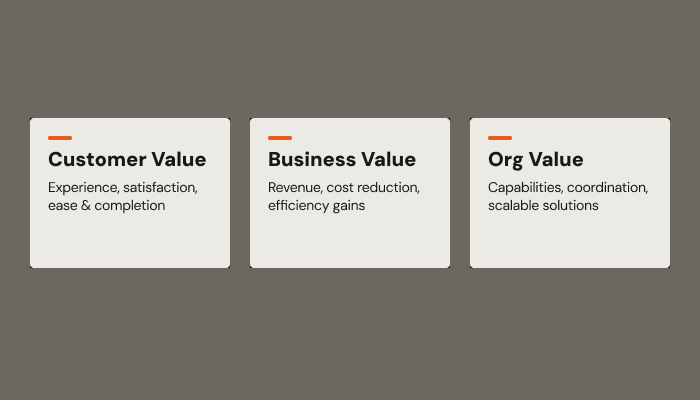
I think about service design impact across three dimensions:
Customer value — Direct impact on their experience (ease, satisfaction, joy)
Business value — Metrics the business cares about (increasing revenue, reducing costs, improving efficiency)
Organizational value — The capabilities and ways of working that enable both customer and business outcomes (scalable solutions, better coordination, reduced redundancy, faster alignment)
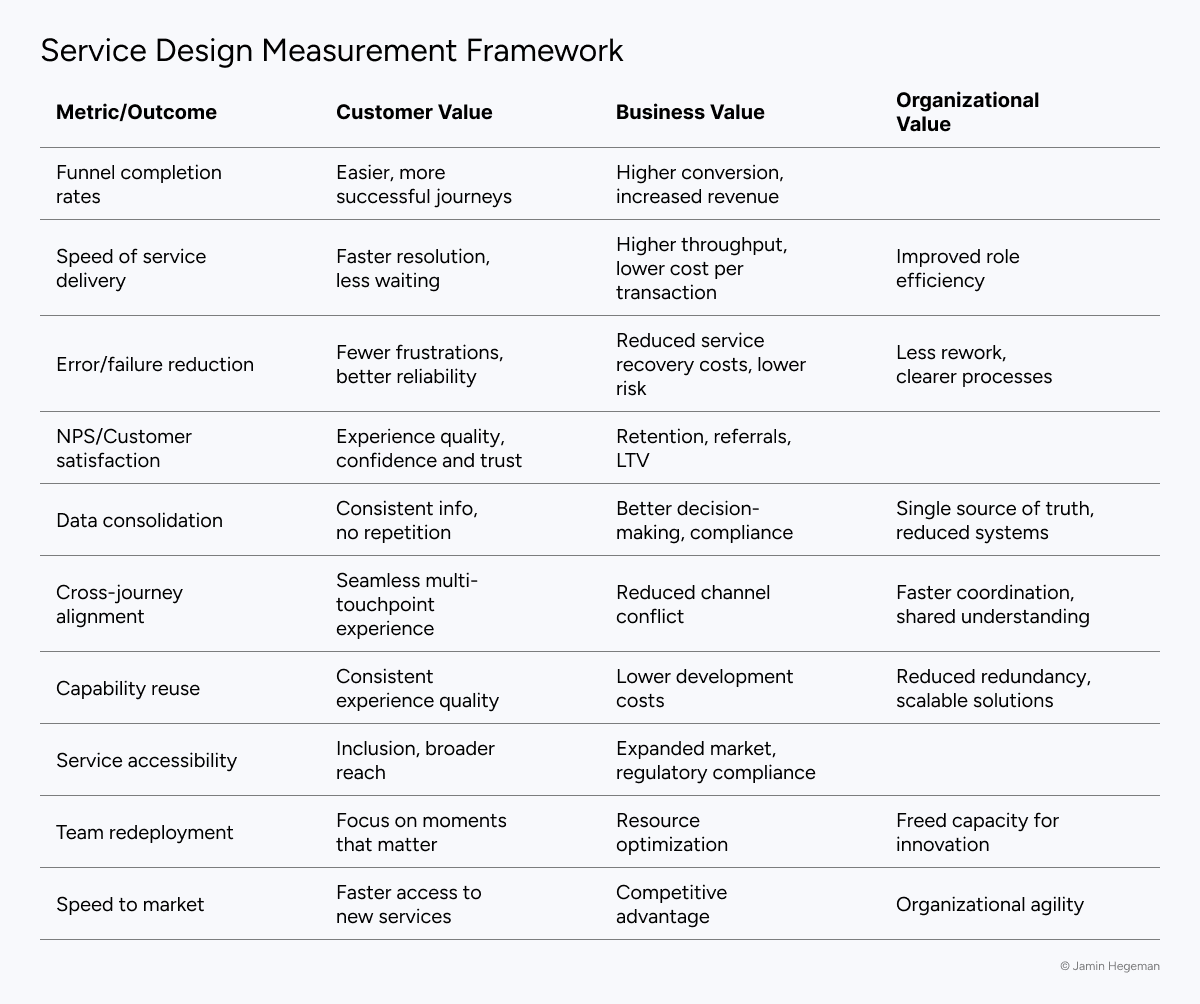
Service design is typically engaged for customer value problems. Use this framework to identify—and capture—the business and organizational value that almost always exists alongside it.
I know there’s a fine line between business value and organizational value, but I find it helpful to distinguish direct business metrics from the organizational capabilities that drive sustainable performance.
How to use this framework
When I’m framing a problem or project—whether with clients or colleagues—I quickly scan through these three dimensions, listening for signals about where service design can provide value. It’s not always necessary to know the exact metrics upfront, but it’s important to articulate where you expect to see impact and get alignment on that with stakeholders.
Then, follow through—track whether the things you intended to influence have actually been impacted. This creates a much stronger conversation with partners because you’re speaking their language and addressing problems they care about.
These three dimensions aren’t isolated—they’re deeply interconnected, and service design’s value often lies in making those connections visible.
Example
Here’s a pattern I see repeatedly: Service design gets brought in to improve a customer journey—reduce friction, increase completion rates, improve satisfaction. That’s the stated problem, and it’s customer value work. But as you map the journey and examine the supporting processes, you discover that three different teams are building similar capabilities independently. Suddenly, you’ve also uncovered organizational value (coordination gaps, duplicated effort) and business value (consolidation opportunities, cost reduction).

The inverse is also true. Sometimes an organization realizes multiple teams are working on the same thing—there’s obvious inefficiency or misalignment. When service design investigates, it reveals the root cause: there’s no clear journey ownership or management structure. The organizational symptom points back to fragmented customer experiences and unclear accountability for end-to-end outcomes.

This is where service design’s systems-thinking perspective becomes most valuable. We see across silos in ways that individual functions often can’t. A product team optimizing their feature might not see that two other teams are solving the same customer problem differently. Operations improving their process might not see how it creates friction at a different touchpoint. Service design makes those connections visible—and that visibility itself is valuable across all three dimensions.
Try it yourself
We still live in a world where design is poorly understood, and service design is even more niche. The more you can connect your work to metrics of value—and show how your work influenced those outcomes—the better.
This framework helps you identify where to look for that compound value—so you can capture it, communicate it, and build a stronger case for service design’s strategic role.
You won’t influence all three dimensions in every project, and you shouldn’t try to claim everything (that dilutes the story). But by being intentional about which dimensions you’re targeting and tracking your influence, you build a clearer narrative about when and why to engage service design.
Use this framework when you start a project or reflect on work you’re currently doing. Listen for these dimensions when talking to potential clients or colleagues. See what resonates.
I’d love to hear how it works for you—and what you’re using to make the case for service design value. This is a critical conversation for our field, and one where we should help each other out.